
Pacific Recycling Foundation Receives Artwork from UNSW at Sydney Circular Economy Hotspot
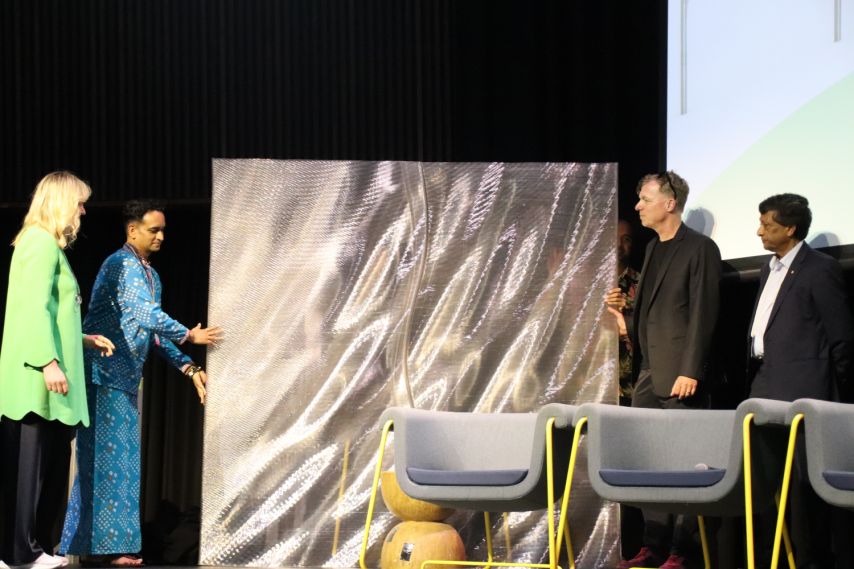
A visual representation of Pacific waste and recycling realities took centre stage at the Sydney Circular Economy Hotspot, as Pacific Recyclers Alliance (PRA) members used art, culture and storytelling to bring grassroots experiences into the wider global circular economy conversation.
The University of New South Wales (UNSW) formally handed over the artwork to the Pacific Recycling Foundation (PRF) during the Hotspot, carrying a message that a circular economy must include grassroots organisations and communities already working within waste and recycling realities.
The artwork is a testament to UNSW’s support for finding solutions through an upcycling model for hard-to-recycle plastics in Fiji and the wider Pacific.
An active working group, established earlier this year, will now work with Professor M. Hank Haeusler,Director ARC Centre for Next-Gen Architectural Manufacuting (Arch_Manu) at the School of Built Environment, University of New South Wales (UNSW), Sydney, to explore and model sustainable housing solutions using hard-to-recycle plastics.
Discussions are also underway with architectural and engineering agencies to incorporate building compliance requirements into the proposed model homes.
The first model house is planned to be trialled on a farm in Fiji, with the aim of establishing best practices that can later be scaled within Fiji and shared with Pacific Recyclers Alliance members across the Pacific region.
For the Pacific Recyclers Alliance, the work demonstrates how circular economy approaches can move beyond discussions into practical solutions for Pacific communities.
“A circular economy can be created, but it should also include grassroots organisations and community recyclers,” said Amitesh Deo, Founder and CEO of the Pacific Recycling Foundation.
Reflecting on the significance of the artworkand the collaboration between UNSW and Pacific partners, Professor Hank Haeusler said:
“In a circular future all nationsaround the globe need to reconsider their selection of building materials. Using recycled plastic with 3D printing will assist in two ways, one it reduces the amount of plastic pollution, and two if creates climate resilient houses for local communities.”
The artwork also formed part of the wider storytelling approach taken by Pacific Recyclers Alliance members throughout the Sydney Circular Economy Hotspot. Through art, traditional attire and cultural expressions, Pacific participants brought attention to the realities of waste management across the region while highlighting the role of grassroots organisations in developing solutions.
The use of traditional attire was not simply a visual representation, but a reminder that environmental solutions cannot be separated from the people, cultures and identities of the communities they are intended to serve.
“When discussions around fixing the world have to take place, let’s not forget that these grassroots groups have existed,” said Deo.
Grassroots recycling organisations across the Pacific continue to collect, sort and recover materials while developing approaches suited to their local contexts. Their experience provides practical knowledge that can contribute to wider discussions on circular economy systems.
The Sydney Circular Economy Hotspot also provided an opportunity for the PRA to connect its Pacific experience with the wider global discussions that will continue towards COP31.
Following its participation in regional discussions in Vanuatu, the PRA’s presence in Sydney represents another step in ensuring that Pacific grassroots recycling organisations have a place in conversations shaping the future of waste management and circular economy approaches.
The journey from regional discussions to an international platform also provides an opportunity to carry Pacific experiences into the wider conversations leading towards COP31, ensuring that the realities, knowledge and solutions developed by grassroots organisations are part of the discussion.
As global conversations continue to focus on circular and sustainable systems, the experiences of grassroots organisations must remain part of the conversation. The artwork provides a way for the Pacific story to be seen, experienced and carried beyond the event, connecting grassroots recycling realities with practical solutions and the wider future of the circular economy.
The Sydney Circular Economy Hotspot was held from 1–3 October 2026.